Nepal has a long history shaped by ancient kingdoms, religion, Himalayan trade, migration and political change. Before Nepal became a unified country, many kingdoms, small states and communities existed across the mountains, hills and southern plains.
For a traveller, Nepal’s history is not something you only find in museums. You see it in the old streets of Kathmandu, the temples of Patan and Bhaktapur, the monasteries of the Himalayas, the traditional villages of Mustang and the mountain trails that have connected communities for generations.
Nepal’s history includes the early Kirat and Licchavi periods, the Malla kingdoms of the Kathmandu Valley, the unification of Nepal under Prithvi Narayan Shah, the Rana period, the restoration of democracy, the 1996–2006 conflict and the abolition of the monarchy in 2008. Nepal is now a federal democratic republic under the Constitution adopted in 2015.
Nepal History at a Glance
| Period / Date |
Major Development |
Why It Matters |
| Early period |
Gopala, Mahishapala and Kirat traditions |
Early development of settlements and political communities |
| Licchavi period |
Stronger written and inscriptional evidence |
Growth of administration, religion, art and trade |
| Malla period |
Kathmandu Valley divided into three kingdoms |
Major development of Newar art, architecture and urban culture |
| 1769 |
Prithvi Narayan Shah conquered the Kathmandu Valley |
Kathmandu became the capital of unified Nepal |
| 1846 |
Rana rule began |
Hereditary Rana prime ministers controlled the government |
| 1950 |
Annapurna I was climbed |
Beginning of Nepal’s modern mountaineering era |
| 1953 |
Everest was first confirmed climbed |
Nepal gained worldwide attention for its mountains |
| 1959 |
First democratic national election |
Beginning of Nepal’s first elected government |
| 1990 |
Multiparty democracy restored |
End of the Panchayat system |
| 1996–2006 |
Maoist armed conflict |
Major political and social turning point |
| 2008 |
Monarchy abolished |
Nepal became a Federal Democratic Republic |
| 2015 |
Current Constitution adopted |
Federal democratic republican system established |
Early History of Nepal
The earliest history of Nepal combines traditional accounts with archaeological and historical evidence. Traditional histories mention the Gopala, Mahishapala and Kirata rulers of the Kathmandu Valley, although the evidence for these early periods is not as detailed as it is for later centuries.
The Kathmandu Valley became an important settlement because of its fertile land and its position between the Indian plains and Tibet. This location encouraged trade and the movement of people, religions, art and ideas across the Himalayas.
Over time, settlements grew into organised political centres. The valley became particularly important because agriculture, trade and skilled craftsmanship could support a growing population.
The Kirat Period
The Kiratas are traditionally regarded as one of the early ruling groups of the Kathmandu Valley. Their history is also associated with communities in eastern Nepal, where Kirat languages, traditions and religious practices remain important today.
There are limited contemporary written records from this period, so some accounts come from later historical traditions. For this reason, the early history of Nepal needs to be read with a distinction between traditional accounts and evidence supported by inscriptions or archaeology.
The Kirat period is nevertheless important when looking at the long development of Nepal’s communities and political history.
The Licchavi Period
The Licchavi period provides some of the earliest substantial written evidence for Nepal’s history. Inscriptions from this period give historians a clearer picture of government, religion, land ownership and society in the Kathmandu Valley.
The valley developed as an important centre of administration, trade, sculpture and architecture. Hindu and Buddhist traditions both became deeply established during this period, leaving monuments and inscriptions that can still be seen today.
Changu Narayan is particularly important. Its temple complex contains an early inscription dating to the fifth century AD, making it an important source for understanding Nepal’s recorded history.
Hinduism and Buddhism in Nepal
Religion has been part of Nepal’s history for centuries, with Hinduism and Buddhism developing alongside one another. Temples, stupas, monasteries and shrines became closely connected with local communities rather than existing separately from everyday life.
Lumbini in southern Nepal has a different place in this history. UNESCO recognizes it as the birthplace of Siddhartha Gautama, the Buddha, and archaeological evidence at the site includes the Ashoka Pillar dating to the 3rd century BC.
The relationship between religion and daily life is still easy to see when travelling through Nepal. A temple can be a historic monument, a place of worship and an active part of the local neighbourhood at the same time.
For more on Nepal’s religious traditions, see our guide to Spirituality in Nepal.
The Malla Period
The Malla period had a major influence on Nepal’s architecture, art and urban culture. Rulers developed temples, palaces, courtyards, public squares and religious institutions, while traditional crafts, music and literature also developed.
One of the most important changes came after the death of Yaksha Malla. The Kathmandu Valley was divided into three kingdoms: Kathmandu, Patan and Bhaktapur.
The three kingdoms competed with each other politically, but that competition also encouraged investment in architecture, festivals, art and public buildings. Much of what visitors now recognise as the historic character of the Kathmandu Valley comes from this period.
Kathmandu, Patan and Bhaktapur
The three cities developed their own identities while remaining connected through trade, religion and shared Newar traditions. Their historic areas now form part of the Kathmandu Valley UNESCO World Heritage property.
The property also includes important religious sites such as Swayambhunath, Boudhanath, Pashupatinath and Changu Narayan.
Kathmandu
Before the unification of Nepal, Kathmandu was known as Kantipur and was one of the three Malla kingdoms. It was already an important political and commercial centre before it became the capital of unified Nepal.
Kathmandu Durbar Square preserves temples, courtyards and palace buildings from different periods. Around the square, the older streets also show how traditional urban life developed around religious and commercial centres.
Patan
Patan, now officially Lalitpur, became particularly known for Newar art, Buddhist monasteries, metalwork and temple architecture. Patan Durbar Square remains one of the best places to see the craftsmanship associated with the valley’s historic period.
The traditional bahals, courtyards and narrow streets are also important. They show that historic architecture was not built only for rulers but was closely connected with religious institutions and ordinary neighbourhood life.
Bhaktapur
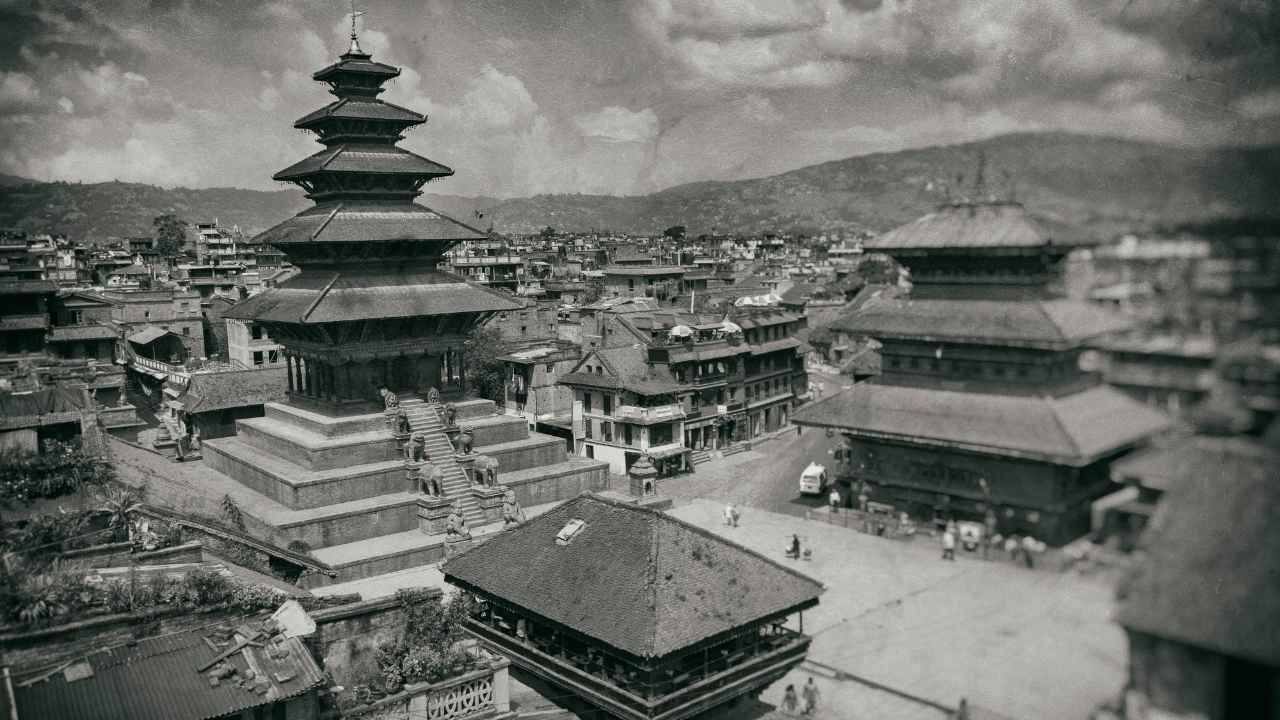
Bhaktapur has preserved much of its traditional urban character. Brick streets, courtyards, temples and historic buildings make it one of the most distinctive places to experience the medieval history of the Kathmandu Valley.
The Palace of 55 Windows, Golden Gate and Nyatapola Temple are among its best-known landmarks. Walking through Bhaktapur gives a better understanding of how architecture, religion and community life were connected.
The Geography That Shaped Nepal’s History
Nepal’s geography has always influenced where people settled, how they travelled and how communities interacted.
The Terai in the south provided fertile agricultural land and direct connections with the Indian plains. The middle hills supported farming communities and settlements, while the high mountains created routes linking Nepal with Tibet.
The Kathmandu Valley occupied an important position between these regions. Its location, fertile land and access to trade helped it develop into a major political, religious and cultural centre.
This geographical variety also helps explain Nepal’s remarkable cultural diversity. A country stretching from the lowlands to the world’s highest mountains developed very different communities and ways of life within a relatively small area.
The People and Communities of Nepal
Nepal’s history cannot be understood only through kings and political events. The country has been shaped by many communities, each with its own languages, traditions, religions and local history.
Newars played a major role in the development of Kathmandu Valley’s urban culture, art and architecture. Sherpa communities became closely associated with the high Himalayas, while Tamang, Gurung, Magar, Rai, Limbu, Tharu, Madhesi and many other communities developed distinctive traditions in different regions.
These communities continue to shape Nepal today. Their food, festivals, clothing, architecture, languages and religious practices are part of what travellers experience when they move beyond the main cities.
Communities You May Encounter While Travelling in Nepal
- Newar: Strongly associated with the Kathmandu Valley’s historic urban culture, architecture and craftsmanship.
- Sherpa: Closely associated with the high Himalayan regions, particularly the Everest area.
- Tamang: Found widely across the hills north of Kathmandu and in several Himalayan districts.
- Gurung: Traditionally associated with the central hills and major trekking areas around Annapurna and Manaslu.
- Magar: One of Nepal’s major ethnic communities, with strong roots in the western and central hills.
- Rai and Limbu: Indigenous communities with deep historical connections to eastern Nepal.
- Tharu: Traditionally associated with the Terai and the southern plains.
- Madhesi communities: A diverse population with deep cultural and historical connections to Nepal’s southern plains.
For a closer look, see our guide to Culture of Nepal.
Nepal Before Unification
The Nepal shown on a modern map did not exist as one unified state during most of its early history.
The Kathmandu Valley contained three major kingdoms, while many smaller kingdoms and principalities existed across the hills and mountains. Some were closely connected through trade and marriage, while others competed for territory and political influence.
One of these states was the Kingdom of Gorkha, ruled by the Shah dynasty. Its ruler Prithvi Narayan Shah would eventually change the political map of the region.
Prithvi Narayan Shah and the Unification of Nepal
Prithvi Narayan Shah became king of Gorkha in the 18th century and began a campaign to bring many of the independent states under one kingdom.
After years of military campaigns, Gorkha forces conquered Kathmandu, Patan and Bhaktapur by 1769. Prithvi Narayan Shah then moved the capital from Gorkha to Kathmandu.
The unification process continued beyond the Kathmandu Valley as the new state expanded and consolidated its territory. It created the foundation of modern Nepal, although the country’s many regional identities and communities remained.
The Shah dynasty ruled Nepal until the monarchy was abolished in 2008.
Nepal and the Himalayan Trade Routes
Nepal’s position between the Indian plains and the Tibetan Plateau made it an important link in Himalayan trade.
Traders, pilgrims and local communities used mountain passes and valleys to move goods and people between the two regions. Salt, wool, grain and other goods were among the products historically exchanged across these routes.
Mustang and Manang developed particularly strong connections with trans-Himalayan trade. Their villages, architecture and landscapes still reflect this history.
The Manaslu region also contains an old salt-trade route along the Budhi Gandaki River. Parts of today’s Manaslu trekking route follow this historic landscape.
This is one reason I often tell trekkers that a mountain trail is not just a line on a map. Many routes pass through places where people have been travelling, trading and living for generations.
The Rana Period
A major political change came in 1846 when Jung Bahadur Rana became Nepal’s dominant political figure. The Rana family established a hereditary system of prime ministers that lasted for 104 years.
The Shah kings remained formally on the throne, but political power was concentrated in the Rana family. During this period, Nepal remained relatively isolated from the outside world compared with later decades.
The Rana period also left a strong architectural mark on Kathmandu. Large palace buildings influenced by European styles appeared alongside older temples, courtyards and traditional Newar architecture.
The Rana system ended during the political changes of the early 1950s, opening Nepal to a new period of political development.
Nepal’s First Democratic Elections
Nepal held its first democratic national election in 1959. The Nepali Congress won the election, and Bishweshwar Prasad Koirala became prime minister.
The democratic government lasted only briefly. In 1960, King Mahendra dismissed the government and dissolved Parliament, beginning the Panchayat political system.
Under the Panchayat system, political parties were restricted and Nepal remained under a partyless political structure for several decades.
The Return of Multiparty Democracy
The People’s Movement of 1990 brought major political change. King Birendra accepted constitutional reforms, and Nepal returned to a multiparty parliamentary system.
Parliamentary elections followed in 1991. The following years saw several changes of government and continuing political instability.
In 1996, an armed conflict began between the government and Maoist rebels, creating another major turning point in Nepal’s modern history.
The 1996–2006 Conflict
The Maoist insurgency began in 1996 and continued for ten years. The conflict affected communities across Nepal, including many rural areas.
The conflict eventually led to negotiations between the government and Maoist representatives. In 2006, the two sides signed the Comprehensive Peace Agreement, formally ending the armed conflict.
The agreement opened the way for elections to a Constituent Assembly and a wider process of political restructuring.
Nepal Becomes a Republic
Nepal held elections for a Constituent Assembly in April 2008. The elected assembly was given responsibility for writing a new constitution and determining the country’s political future.
On 28 May 2008, the Constituent Assembly declared Nepal a Federal Democratic Republic and abolished the monarchy.
This ended the Shah monarchy, which had ruled unified Nepal since the time of Prithvi Narayan Shah. Nepal then moved toward a republican political system with an elected government and a president as head of state.
The 2015 Constitution and Federal Nepal
Nepal adopted its current Constitution on 20 September 2015.
The Constitution established Nepal as a federal democratic republican state and created three levels of government: federal, provincial and local.
Federalism changed the country’s administrative structure by giving provincial and local governments defined responsibilities. It marked another major stage in Nepal’s transition from the older centralized system.
The Gurkhas and Nepal’s Military History
The history of Nepal is also closely connected with the Gurkhas.
Following the Anglo-Nepalese War of 1814–1816, recruitment of Nepali soldiers into British military service developed into a long tradition. Gurkha soldiers later served in conflicts around the world, including both World Wars.
Gurkha service also became economically important for many families and communities in Nepal. Their history is now part of Nepal’s international story as well as the military history of Britain and other countries where Gurkha soldiers have served.
The History of Trekking and Mountaineering in Nepal
Modern mountaineering added another important chapter to Nepal’s history during the 20th century.
Annapurna I became the first mountain above 8,000 metres to be climbed when Maurice Herzog and Louis Lachenal reached the summit on 3 June 1950. The expedition took place on the northern side of the mountain in what is now one of Nepal’s best-known trekking regions.
Three years later, Edmund Hillary and Tenzing Norgay made the first confirmed ascent of Mount Everest on 29 May 1953. The achievement brought worldwide attention to Nepal and its Himalayan mountains.
As interest in the mountains increased, organised trekking and mountaineering gradually developed. By the 1960s, private companies were providing guides, porters and logistical support for expeditions.
Trekking eventually became much broader than climbing. Visitors could travel through Himalayan villages, cross high passes and experience mountain landscapes without attempting a summit.
Everest, Annapurna, Langtang, Manaslu and other regions gradually became established trekking destinations. Today, trekking is one of the most important ways international visitors experience Nepal.
How Nepal’s History Shaped Trekking
Many of Nepal’s trekking trails are connected with older patterns of settlement, trade and religion.
In the Everest region, Sherpa settlements, monasteries, chortens and mani walls reflect the strong influence of Himalayan Buddhism. The Everest Base Camp Trek therefore takes travellers through both dramatic mountain scenery and living Sherpa communities.
The Annapurna region has a different combination of cultures and landscapes. The Annapurna Circuit Trek crosses areas historically connected with trade between the middle hills and the Tibetan Plateau.
The Manaslu Circuit provides another example. The route follows the Budhi Gandaki valley and part of an old trading landscape before crossing the Larkya La.
When you understand this background, villages and trails look different. A stone path is not always just part of a trekking route; in many places it is part of a much older network used by local people.
Historic Places to Visit in Nepal
You do not need to visit every historical site in Nepal to understand the country’s past. A few places provide a useful introduction to different periods.
| Place |
Historical Importance |
What Travellers Can See |
| Kathmandu |
Former Malla kingdom and later capital of unified Nepal |
Kathmandu Durbar Square, temples, courtyards and old streets |
| Patan |
Major centre of Newar art and Buddhist-Hindu heritage |
Patan Durbar Square, temples, bahals and traditional crafts |
| Bhaktapur |
Important Malla kingdom with preserved traditional architecture |
Nyatapola Temple, Golden Gate and historic squares |
| Lumbini |
Birthplace of Siddhartha Gautama, the Buddha |
Maya Devi Temple, Ashoka Pillar and monastic zone |
| Gorkha |
Home of the Shah dynasty and linked with unification |
Gorkha Durbar and historic palace complex |
| Mustang |
Historic Himalayan trade and Tibetan cultural connections |
Traditional villages, monasteries and old trade landscapes |
| Manang |
Historic trans-Himalayan trade connections |
Traditional settlements and mountain trails |
| Changu Narayan |
Important site for Nepal’s early recorded history |
Temple complex and early inscription |
Nepal’s History Is Still Part of Everyday Life
One thing I find particularly interesting about Nepal is that its history has not disappeared into the past.
In Kathmandu, historic temples stand beside busy streets, restaurants and modern businesses. In Patan and Bhaktapur, old courtyards and religious sites remain part of active neighbourhoods rather than existing only as preserved monuments.
The same is true in the mountains. Traditional houses, monasteries, prayer walls and religious monuments continue to be part of village life.
Festivals, food, clothing, architecture and religious practices also carry traditions from one generation to the next. For travellers, this makes Nepal’s history something you experience while travelling rather than something you simply read about.
You can explore this living side of Nepal in our guides to Festivals in Nepal and Food in Nepal.
Nepal History Timeline
| Year / Period |
Event |
| Early period |
Traditional accounts refer to Gopala, Mahishapala and Kirat rulers of the Kathmandu Valley. |
| Licchavi period |
Inscriptions provide important evidence of administration, religion and society. |
| Malla period |
Kathmandu, Patan and Bhaktapur developed as separate kingdoms. |
| 1769 |
Prithvi Narayan Shah completed the conquest of the Kathmandu Valley and established Kathmandu as capital. |
| 1846 |
Jung Bahadur Rana established the Rana system of hereditary prime ministers. |
| 1950 |
Annapurna I became the first 8,000-metre peak to be climbed. |
| 1953 |
Edmund Hillary and Tenzing Norgay made the first confirmed ascent of Mount Everest. |
| 1959 |
Nepal held its first democratic national election. |
| 1960 |
King Mahendra dismissed the government and dissolved Parliament. |
| 1990 |
The People’s Movement restored multiparty democracy. |
| 1996 |
The Maoist armed conflict began. |
| 2006 |
The Comprehensive Peace Agreement formally ended the conflict. |
| 2008 |
Nepal became a Federal Democratic Republic and abolished the monarchy. |
| 2015 |
Nepal adopted its current Constitution and established its federal structure. |
Frequently Asked Questions About Nepal History
How old is Nepal’s history?
Nepal’s history stretches back many centuries. Traditional accounts cover some of the earliest rulers, while inscriptions, archaeological evidence and historic monuments provide stronger evidence for later periods such as the Licchavi and Malla eras.
Who unified Nepal?
King Prithvi Narayan Shah of Gorkha led the campaigns that brought many independent states under one kingdom. He conquered the Kathmandu Valley in 1769 and established Kathmandu as the capital of unified Nepal.
What is the oldest historical site in Nepal?
There is no single simple answer because Nepal has several very old archaeological and religious sites. Changu Narayan contains an early inscription from the Kathmandu Valley, while Lumbini contains archaeological evidence connected with Buddhist pilgrimage dating back to the 3rd century BC.
Why is Kathmandu important in Nepal’s history?
Kathmandu became an important political, religious and commercial centre long before it became the capital of unified Nepal. Its position in the Kathmandu Valley also helped connect trade and cultural exchange between the southern plains and the Himalayan region.
When did Nepal become a republic?
Nepal became a Federal Democratic Republic on 28 May 2008, when the Constituent Assembly abolished the monarchy.
When did Nepal adopt its current Constitution?
Nepal adopted its current Constitution on 20 September 2015. It established the country as a federal democratic republican state with federal, provincial and local governments.
What role did the mountains play in Nepal’s history?
The Himalayas were not simply a natural barrier. Mountain valleys and passes connected Nepal with Tibet and supported trade, migration and pilgrimage.
Why is Nepal’s history important for trekkers?
Many trekking routes pass through villages, monasteries and landscapes shaped by centuries of trade, religion and migration. Knowing some of this history gives more meaning to the places you see along the trail.
What historical places should I visit in Nepal?
Kathmandu, Patan, Bhaktapur, Lumbini and Gorkha are important historical destinations. In the mountains, Mustang and Manang provide insight into traditional Himalayan settlements and old trade connections.
Experience Nepal Beyond the Mountains
Nepal’s history is not simply a list of kings, dates and political changes. It is the story of communities, religions, trade routes, changing borders and people adapting to one of the world’s most varied landscapes.
You can see that history in an old Kathmandu courtyard, in the temples of Patan, in the streets of Bhaktapur, in a monastery above Namche or on an old trail through the Himalayas.
After more than 30 years of travelling and working in Nepal’s mountains, I still find that understanding the background of a place changes the way you experience it. The mountains may bring you to Nepal, but its history, people and living traditions are what make the journey much more than a walk from one place to another.